Business card size: UK and international standards
The standard business card size in the UK and Ireland is 85×55 mm, the same as in most of Western Europe. Poland and much of Central Europe use 90×50 mm, while the USA and Canada use 3.5×2 in (88.9×50.8 mm). Print files are set up with 3 mm of bleed on every side, which gives 91×61 mm for the UK format (1075×720 px at 300 DPI) or 96×56 mm for the Polish format (1134×661 px). Business cards are usually printed on 300–350 g/m² board, and the smallest legible text is 6–7 pt.
Business card size seems obvious until you order printing abroad or receive a file from a designer that doesn't fit your card holder. A few millimetres decide whether the card slips into a wallet, whether text gets trimmed off and whether the printer accepts the file without corrections. In this guide you'll find the standard formats used in different countries, sizes with bleed in millimetres and pixels, and practical advice on what you can sensibly fit onto such a small surface.
What is the standard business card size in the UK?
In the UK and Ireland the standard is 85×55 mm, and practically every printer uses it by default. Popular card holders, cases and organiser slots are made to this size, so an 85×55 mm card doesn't stick out or bend.
Elsewhere the picture is different: in Poland and several other Central and Eastern European countries, including the Czech Republic, Slovakia and Russia, the standard is 90×50 mm. If you work mainly in the UK or Irish market, there's no reason to depart from 85×55 mm unless you deliberately want to stand out with an unusual shape.
Business card sizes in Europe and worldwide – table
Across the UK, Ireland and Western Europe (including Germany, France, Italy, Spain and the Benelux countries) you'll most often come across 85×55 mm. It's close to a payment card (85.6×54 mm), so it fits the card slots in a wallet. The USA and Canada use 3.5×2 in, and in Asia formats vary from country to country.
If your customers or business partners are mainly in one country, choose the format that is standard there. For international contacts 85×55 mm works well, because it fits wallets all over the world.
| Country / region | Size | In millimetres | With 3 mm bleed |
|---|---|---|---|
| Poland, Czech Republic, Slovakia, Russia | 90×50 mm | 90×50 | 96×56 mm |
| UK, Ireland, Western Europe | 85×55 mm | 85×55 | 91×61 mm |
| USA, Canada | 3.5×2 in | 88.9×50.8 | 3.75×2.25 in (0.125 in bleed) |
| Japan | 91×55 mm | 91×55 | 97×61 mm |
| China | 90×54 mm | 90×54 | 96×60 mm |
| Australia, New Zealand | 90×55 mm | 90×55 | 96×61 mm |
| Square format (popular) | 65×65 mm | 65×65 | 71×71 mm |
Business card size with bleed and safe area
Bleed is an extra strip of background that extends beyond the trim line, usually 3 mm on each side. It's needed because the guillotine blade can shift by around 1 mm, and without bleed a white sliver would appear at the edge. That's why backgrounds, photos and coloured areas must run right to the edge of the file with bleed.
The safe area works the other way round: it's a zone inside the format where you don't place anything important. The minimum is 3 mm from the trim line, and 4–5 mm is safer. For an 85×55 mm card with a 3 mm margin, text and logo should fit within 79×49 mm; for a 90×50 mm card, within 84×44 mm.
Some printers ask for 2 mm of bleed, others 5 mm, especially for die-cut custom shapes. Always check your printer's specification before exporting the file.
| Trim size | File with bleed | Trim size in pixels (300 DPI) | Pixels with bleed (300 DPI) | Safe area (3 mm margin) |
|---|---|---|---|---|
| 90×50 mm | 96×56 mm | 1063×591 px | 1134×661 px | 84×44 mm |
| 85×55 mm | 91×61 mm | 1004×650 px | 1075×720 px | 79×49 mm |
| 3.5×2 in | 3.75×2.25 in | 1050×600 px | 1125×675 px | approx. 3.25×1.75 in |
| 65×65 mm | 71×71 mm | 768×768 px | 839×839 px | 59×59 mm |
Square and custom business cards – when are they worth it?
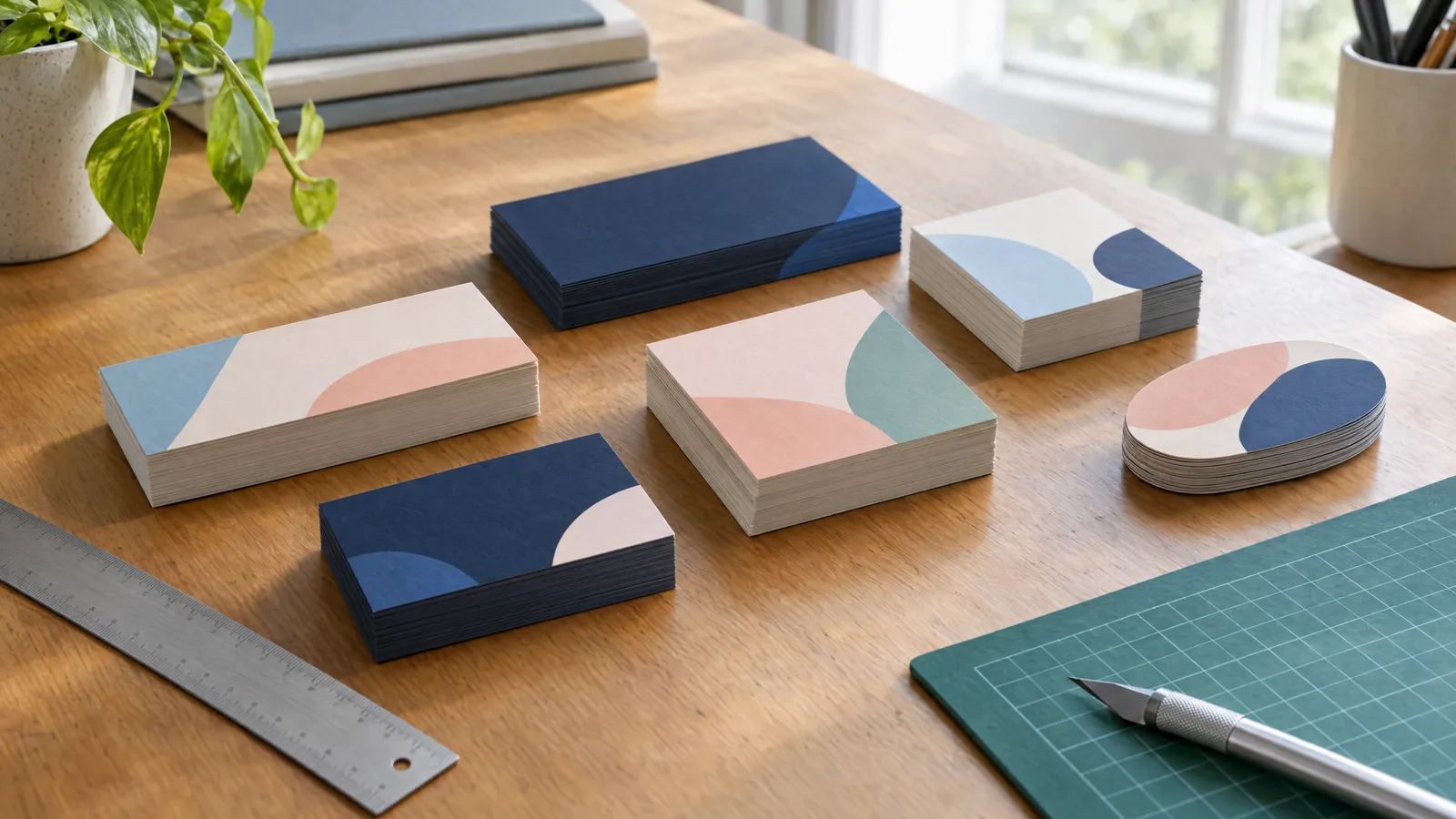
A square business card (most often 65×65 mm, though 55×55 and 50×50 mm are also used) catches the eye straight away and suits creative fields well: photography, architecture, floristry, hospitality or beauty. It works best when you have a strong, symmetrical logo and little text.
The drawback is practicality: a square won't fit a standard card holder or wallet slot, so some people will slip it loose into a pocket or put it aside. Printing can also cost a little more, because the sheet is used less efficiently. The same goes for rounded corners or die-cuts in the shape of a product: they look striking, but need extra finishing.
- 65×65 mm square – stands out, fits a logo and 3–4 lines of contact details.
- Mini card (e.g. 70×28 mm) – just a name and one contact channel, common in fashion.
- Rounded corners – keep the standard size while adding a softer feel; radius usually 3–5 mm.
- Folded card – standard size when folded, with room inside for, say, a price list or a location map.
What should go on a business card?
On a surface of 85×55 or 90×50 mm the best rule is: one person, one business, one main contact. The more details you add, the smaller the type and the harder it is to find what matters most. If there's a lot of information, move some of it to the reverse, e.g. logo and strapline on the front, contact details on the back.
Set the name or business name at 10–14 pt and the contact details at 7–9 pt. Don't go below 6 pt, and with thin typefaces or white text on a dark background stick to a minimum of 7 pt. Lines and strokes shouldn't be thinner than 0.25 pt, as they may disappear in print.
- Name – the largest text element after the logo.
- Job title or specialism – one short description, e.g. “Accountant” rather than a full title.
- Logo – ideally in vector form, with its clear space preserved.
- Phone number – in an easy-to-read format, e.g. 07700 900123.
- Email and website – short, without “http://”.
- Address – only if customers come to you.
- QR code – at least approx. 2×2 cm, linking to your website or a digital business card; test that it scans before printing.
- Social media – one or two profiles you actually keep up to date.
85×55 or 90×50 mm – what should decide your choice?
The choice of format depends mainly on where and to whom you hand out your cards. In the UK and Ireland 85×55 mm is the safe standard, while 90×50 mm, although only slightly different, is longer and may not fit a snug UK card holder. When dealing with businesses in Poland or elsewhere in Central Europe, the 90×50 mm format will look natural.
The layout of the design matters too. The 85×55 mm format is less elongated, so it suits vertical compositions and a larger logo better, while 90×50 mm gives more horizontal room for longer email addresses and business names. Portrait orientation is perfectly acceptable for both formats: the size doesn't change, you simply swap width and height.
| Criterion | 90×50 mm | 85×55 mm |
|---|---|---|
| Main market | Poland, Central and Eastern Europe | UK, Ireland, Western Europe, international contacts |
| Card holders | Fits standard Polish holders; may be too long for snug UK models | Fits standard UK and European holders |
| Wallet | Fits most card slots | Perfect fit, like a payment card |
| Layout character | More elongated, good for long lines of text | More compact, better for a larger logo |
How to prepare a business card file for print
Prepare the print file at the final size with bleed, at 300 DPI for raster elements and in the CMYK colour space. The safest format is a PDF with embedded fonts or text converted to outlines. Logos and text are best kept as vectors, as they'll stay sharp at any scale.
The standard weight is 300–350 g/m², and for a thicker, more luxurious feel 400 g/m² or more. Matt or soft-touch lamination protects against scuffing, and spot UV varnish makes a logo stand out. Don't put thin borders right next to the edge: if the trim shifts by 1 mm, it's immediately obvious that the border is uneven.
If you order a design from plakaty.shop (wielkareklama.eu studio), you receive PNG and print-ready PDF files at trim size with 3 mm bleed and a safe area, in 90×50 mm, 85×55 mm or as a 65 mm square. Wherever your design comes from, proofread all text, phone numbers and addresses yourself before printing.
Checklist
- Trim size matches the target market (85×55, 90×50 mm or other)
- 3 mm bleed on every side, background runs to the edge of the file
- Text and logo at least 3 mm from the trim line
- Smallest type no smaller than 6–7 pt
- Raster graphics at 300 DPI, colours in CMYK
- Fonts embedded or converted to outlines in the PDF
- QR code tested with a phone
- Name, phone number, email and address proofread letter by letter
- No thin borders right next to the edge of the format
FAQs
What is the standard business card size in the UK?
The standard business card size in the UK and Ireland is 85×55 mm, which means a 91×61 mm print file with 3 mm bleed on each side. In Poland the standard is 90×50 mm, or 96×56 mm with bleed. Popular card holders and cases are made to fit the local format.
How many pixels is a 90×50 mm business card?
At 300 DPI a 90×50 mm business card is 1063×591 px. With 3 mm bleed, i.e. at 96×56 mm, the file should be 1134×661 px. For the UK 85×55 mm format it's 1004×650 px, or 1075×720 px with bleed. Logos and text are best saved as vectors, so resolution doesn't apply to them.
What's the difference between an 85×55 and a 90×50 mm business card?
85×55 mm is the UK and Western European standard, close to a payment card, so it fits wallet card slots perfectly. The Polish 90×50 mm format is 5 mm longer and 5 mm shorter in height. The choice depends on where you hand out cards most often and the kind of layout you need.
What size is an American business card?
In the USA and Canada the standard is 3.5×2 in, i.e. 88.9×50.8 mm. Bleed there is usually 0.125 in on each side, so the file measures 3.75×2.25 in. At 300 DPI that's 1050×600 px at trim size.
What size is a square business card?
The most popular is a 65×65 mm square, though 55×55 and 50×50 mm are also used. A 65×65 mm file with 3 mm bleed measures 71×71 mm. Bear in mind that a square won't fit a standard card holder.
What paper weight is best for business cards?
Most people choose 300–350 g/m² board, which is rigid and doesn't crease in a wallet. For a premium effect, 400 g/m² or more, or speciality papers, are used. Matt or soft-touch lamination also protects the card from scuffing.