Advertising Slogans: 40 Examples and How to Write Your Own
A good advertising slogan usually has 3–7 words, one idea and a clear benefit for the customer. The easiest way to write one is with one of five methods: benefit, number, question, rhyme or contrast. On an A5 flyer a slogan is usually set at 24–40 pt. On a banner, the rule of thumb is a minimum letter height of about 2.5 cm for every 3 m of viewing distance, so text read from 15 m needs letters roughly 12–13 cm tall.
Your slogan is often the only text a customer will actually read on your banner, poster or flyer. They give it a few seconds at most, so every word counts. Below you'll find what makes a good slogan, five proven methods for writing one, 40 made-up examples for different trades, a list of common mistakes and a simple test to run before you send your artwork to print.
What makes a good advertising slogan?
A good slogan tells customers what they'll gain, not just who you are. It's short enough to take in at a glance and specific enough that it doesn't fit every other business in the area. If your slogan could be pinned on a competitor without changing a word, it isn't finished yet.
- Brevity: 3–7 words, and ideally 3–5 on a banner or shop sign.
- One idea: one promise or one image, not three at once.
- Benefit: it answers the customer's question, ‘What's in it for me?’.
- Specifics: a number, a time, a place or a result instead of vague claims such as ‘top quality’.
- Rhythm: it sounds good read aloud and is easy to repeat.
- Honesty: you can keep the promise and, if needed, prove it.
- Brand tone: a law firm speaks differently from an ice-cream parlour.
5 methods for writing slogans: benefit, number, question, rhyme, contrast
You don't need to wait for inspiration. Most effective slogans follow a handful of repeatable patterns. Write 3–5 versions using each method, then pick the best one rather than polishing your first idea.
You can combine methods: numbers work well with contrast, and questions pair nicely with benefits. Use rhyme with care, as a forced rhyme sounds cheesy and undermines credibility in serious sectors such as law or healthcare.
| Method | How it works | Pattern | Where it works best |
|---|---|---|---|
| Benefit | Shows the result the customer gets | [Result] without [problem] | Services, B2B, most sectors |
| Number | Specifics build credibility and catch the eye | [Number] [unit], [result] | Deadlines, prices, turnaround times |
| Question | Engages, because the reader instinctively answers | [Problem]? [Solution] | Emergency services, education, sport |
| Rhyme | Makes it easier to remember and repeat | [Phrase A], [phrase rhyming with A] | Food and drink, local shops, children |
| Contrast | Puts two opposites side by side: before and after | [Before], [after] | Services that change something: cleaning, renovation, beauty |
40 advertising slogan examples for different trades
All the slogans below were made up for this guide, so feel free to rework them. Treat them as a starting point: add your town, your turnaround time or what sets you apart, and the slogan instantly becomes yours.
Before using a slogan with a number or a promise, check you can genuinely deliver it. A slogan like ‘tyres changed in 20 minutes’ commits you just as much as your price list does.
| No. | Trade | Slogan | Method |
|---|---|---|---|
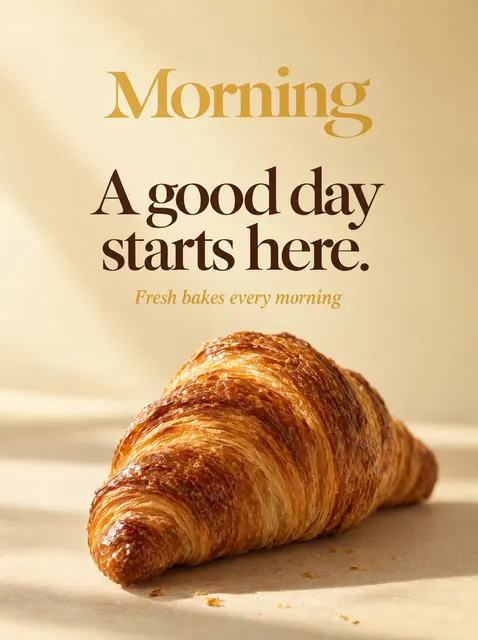
| 1 | Bakery | Bread that smells like morning | Benefit |
| 2 | Cake shop | Homemade taste, not a crumb to waste | Rhyme |
| 3 | Café | Quick coffee, long conversations | Contrast |
| 4 | Pizzeria | 30 minutes from oven to door | Number |
| 5 | Lunch restaurant | Dinner like Mum's, minus the washing-up | Benefit |
| 6 | Diet meal delivery | Five meals, zero cooking | Number + contrast |
| 7 | Hairdresser | A cut that survives Monday | Benefit |
| 8 | Beauty salon | Walk in tired, walk out glowing | Contrast |
| 9 | Barber | Sharp, smart, on time | Rhythm |
| 10 | Gym | How many more fresh starts on a Monday? | Question |
| 11 | Physiotherapy | Less pain, more movement | Contrast |
| 12 | Dental practice | Smile without thinking twice | Benefit |
| 13 | Vet | We treat patients who can't tell us where it hurts | Emotion |
| 14 | Dog groomer | Squeaky clean, the happiest dog you've seen | Rhyme |
| 15 | Car garage | Fixed once, fixed properly | Benefit |
| 16 | Car wash | Drives in dirty, drives out gleaming | Contrast |
| 17 | Tyre centre | Tyres on, worries gone | Rhyme |
| 18 | Plumber | Dripping? Call before it floods | Question |
| 19 | Electrician | Sparking? Best not wait | Question |
| 20 | Renovation company | Renovations on time, without the stress | Benefit |
| 21 | Gardener | You relax, your garden grows | Contrast |
| 22 | Cleaning | You come home, and home is spotless | Benefit |
| 23 | Removals | We pack, we move, we unpack | Rhythm |
| 24 | Accountancy firm | We do the sums so you don't have to | Benefit |
| 25 | Law firm | Plain words on difficult matters | Contrast |
| 26 | Language school | Speak, don't cram | Contrast |
| 27 | Private tutoring | Maths? You might just like it | Question |
| 28 | Nursery | Where children grow up smiling | Benefit |
| 29 | Driving school | Drive confidently, pass calmly | Rhythm |
| 30 | Bike shop | Two wheels, zero traffic jams | Number + contrast |
| 31 | Florist | When words fail, say it with flowers | Emotion |
| 32 | Pet shop | For fur, scales and feathers | Rhythm |
| 33 | Optician | See the difference today | Benefit |
| 34 | Travel agency | You choose the destination, we handle the rest | Contrast |
| 35 | Farm stay | Silence you can hear | Contrast |
| 36 | Wedding photographer | Photos you'll come back to in 20 years | Number |
| 37 | Web design | A website that sells while you sleep | Benefit |
| 38 | Solar panels | Let the sun pay the bills | Image |
| 39 | Windows | Warmth stays in, noise stays out | Contrast |
| 40 | Fitted furniture | Wardrobes fitted to the centimetre | Number |
How to write your own advertising slogan, step by step
Most of the time is best spent on what happens before you start writing. A slogan is a shorthand for your offer, so first you need to know exactly what you're condensing.
- Define your audience: write one sentence about who should read the slogan, e.g. ‘parents of 3–6-year-olds on our estate’.
- Name the customer's problem: list what annoys or worries them, as a good slogan often starts from that pain point.
- Choose one benefit: from your list of strengths, keep the one your competitors don't mention or can't promise.
- Write in batches: 5 versions using each of the five methods, giving you 25 options, without judging as you go.
- Cut it down: remove every word the meaning survives without, especially ‘best’, ‘professional’ and ‘we offer’.
- Read it aloud: if you stumble or need to take a breath, the slogan is too long or the rhythm is off.
- Sleep on it: the next day you'll see straight away which versions sound natural and which sound forced.
What to avoid in advertising slogans
Most weak slogans aren't bad, just bland. Customers walk straight past because the text says nothing they haven't heard a hundred times. The second group of mistakes is slogans that could harm you legally or damage your reputation.
- Empty adjectives: ‘highest quality’, ‘comprehensive service’ and ‘professionalism’ don't set anyone apart.
- Untrue promises: ‘cheapest in the country’ or ‘guaranteed exam pass’ could be judged misleading advertising.
- Copying other people's slogans: well-known slogans are often registered as trade marks, and a reworked version may infringe the owner's rights.
- Industry jargon: customers don't need to know what ‘reconditioning a VGT turbocharger’ means; they want to know their car will run again.
- Several ideas at once: ‘Fast, cheap, reliable, mobile and on finance’ is a list, not a slogan.
- Forced rhymes and wordplay that needs explaining.
- Setting longer text entirely in capitals: all-caps text is slower to read, so keep capitals for short slogans only.
How to test a slogan before printing
The test takes a quarter of an hour or so, and it saves you printing a whole run with a slogan nobody understands. Show the versions to people outside your business, ideally from your customer group, and don't explain anything before they respond.
If you type your slogan into a design brief form, for example on plakaty.shop, the ready-made designs will be built around your text, but you should still proofread for typos and check phone numbers yourself before printing.
- The 3-second test: show the slogan for 3 seconds and ask the person to repeat it; if they didn't take in the meaning, shorten it.
- The competitor test: swap your name for a competitor's; if it still fits, add something that sets you apart.
- The ‘so what?’ test: ask this question after reading the slogan; no answer means no benefit.
- The read-aloud test: you should be able to say the slogan in one breath.
- The distance test: print the design to scale on an A4 sheet and look at it from 2–3 m; this gives a good idea of legibility on a poster or banner.
- The search test: type the slogan in quotation marks into Google and check that another business isn't already using it.
How big should a slogan be on a flyer, poster and banner?
The length and size of a slogan depend on the medium and the distance it's read from. A flyer is held in the hand, while a banner on a fence is passed by car, so the same slogan may need a different length in each version of the campaign.
For media viewed from a distance, a useful rule is a minimum letter height of about 2.5 cm for every 3 m of viewing distance. This is a guideline only: with a bold, simple sans-serif typeface and strong contrast against the background, the slogan will be more legible than with a thin decorative font.
| Medium | Recommended slogan length | Approximate size | Notes |
|---|---|---|---|
| Business card 85×55 mm (or 90×50 mm) | 2–5 words | 9–12 pt | Slogan as a tagline beneath the business name |
| A5 flyer | 3–7 words | 24–40 pt | Slogan as a headline at the top |
| A2/A1 poster | 3–6 words | letters 3–8 cm | Read from a few metres away |
| Roll-up banner 85×200 cm | 3–6 words | letters 6–12 cm | Slogan at eye level, not near the floor |
| Banner 300×100 cm | 3–5 words | letters 15–25 cm | Read on the move, from a dozen to several dozen metres |
| Shop sign 120 cm wide | 2–4 words | depends on distance from the street | Slogan usually smaller than the business name |
Checklist
- The slogan has 3–7 words and one idea
- It contains a specific benefit for the customer
- You can keep and prove the promise in the slogan
- The slogan doesn't copy someone else's slogan or a registered trade mark
- It has passed the 3-second test with someone outside your business
- The letter size suits the reading distance of the medium
- The slogan and text sit within the safe area, not near the trim line
- You've proofread all the text, phone numbers and addresses yourself before printing
FAQs
How do I come up with a good advertising slogan?
Start with one sentence about your customer and their problem, then write several versions using the benefit, number, question, rhyme and contrast methods. Shorten the best options, read them aloud and show them to people outside your business. Choose the slogan that people repeat back in their own words most quickly.
How many words should an advertising slogan have?
Usually 3–7 words. On banners, shop signs and media read on the move, 3–5 words works better, while on a flyer or social media post you can afford a slightly longer version. The further away the reader is, the shorter the slogan needs to be.
Can I register an advertising slogan?
Yes, a slogan can be registered as a trade mark: in the UK with the Intellectual Property Office, in Ireland with the Intellectual Property Office of Ireland, or with the EUIPO for protection across the European Union (which no longer covers the UK). It must be distinctive, so generic phrases such as ‘top quality’ usually won't be accepted. For costs and the details of an application, it's worth getting help from a trade mark attorney.
Does an advertising slogan have to rhyme?
No. Rhyme makes a slogan easier to remember and works well for food and drink or local shops, but a forced rhyme sounds cheesy. In serious sectors such as law, finance or healthcare, slogans based on a benefit or contrast are more effective.
What's the difference between an advertising slogan and a tagline?
In practice they're synonyms. Sometimes a distinction is made between a permanent brand tagline, used for years on your shop sign and business cards, and a campaign slogan that changes with each promotion. Both should share the same tone so customers associate them with one business.
Can I use a slogan from this guide in my own advertising?
The slogans in this guide were made up as examples, so you're free to rework and use them. Even so, check a search engine and the trade mark registers to make sure a business in your sector isn't already using a similar slogan. Ideally, adapt the example to your offer by adding what sets you apart.