Fence Banner: Sizes, Material and Design
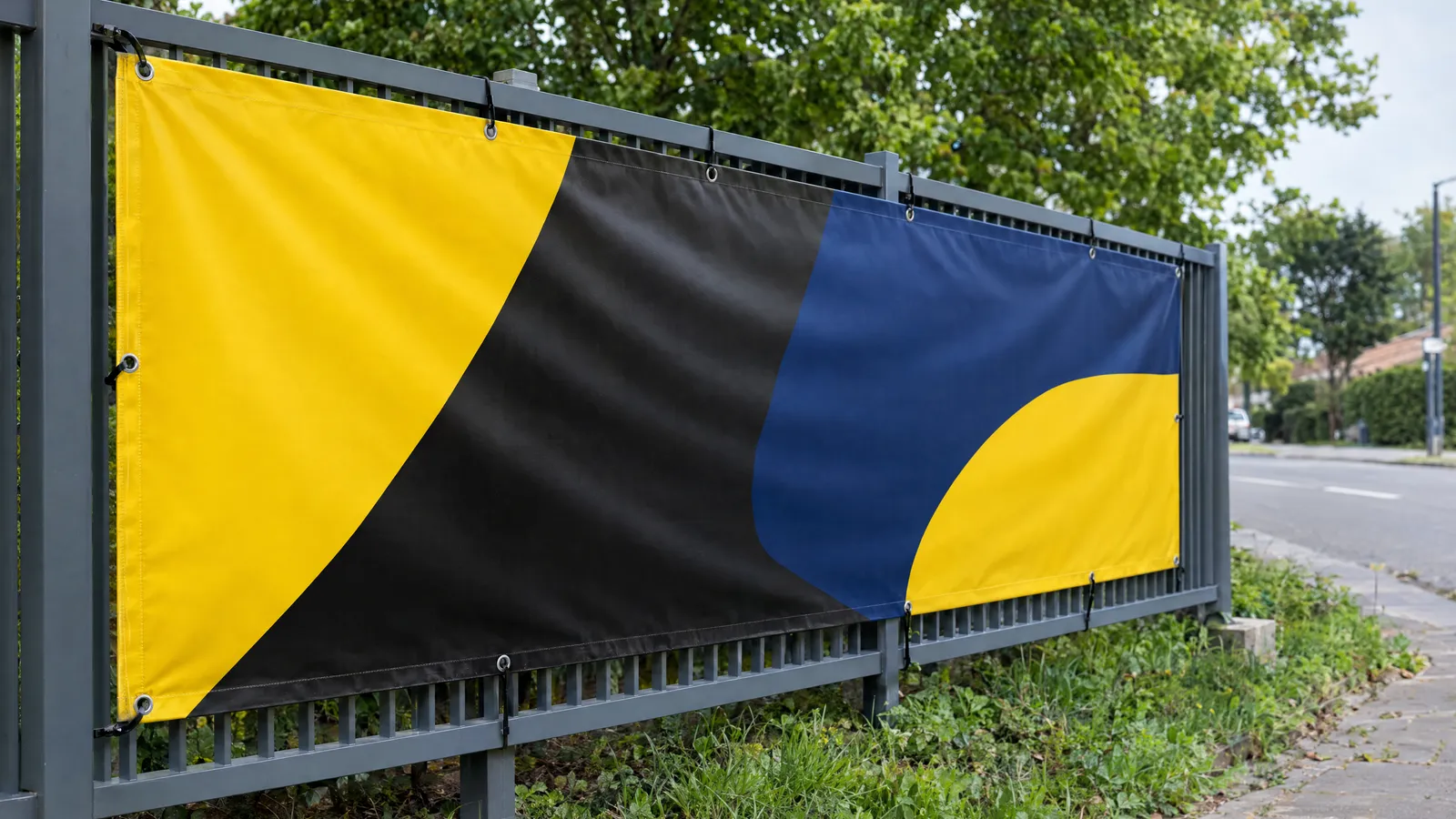
The most popular fence banner sizes are 200×100, 300×100 and 500×100 cm. They are printed on 440–510 g/m² PVC frontlit or, for long fences in windy spots, on mesh of approx. 270–370 g/m². The edges are reinforced with a welded hem and metal eyelets every 30–50 cm. For a driver to read it from 30 m, the main slogan should be about 20 cm tall, with no more than 5–7 words in strong contrast. Supply the file in CMYK at 72–150 DPI at 1:1 scale (720–1500 DPI at 1:10 scale).
A banner on a fence is one of the cheapest forms of outdoor advertising. But it only works if people have time to read it, often through the windscreen of a moving car. This guide covers standard sizes, a comparison of materials, fixing methods, and specific letter heights and colour combinations, so your banner is legible from the street and stands up to wind and rain.
What size should a fence banner be?
The most popular banners are 100 cm high and 2–5 m long. A strip like this fits neatly on typical mesh panel fencing 153–173 cm high and leaves room for fixings. Fence panels are usually 250 cm long, so a 250×100 or 500×100 cm banner covers exactly one or two panels.
Before you order, measure the fence where the banner will go: panel height, post spacing and clearance from the ground. Allow a few centimetres on each side for tensioning, because a banner cut to the exact size of the panel is hard to pull taut.
| Size | Use | Notes |
|---|---|---|
| 200×100 cm | Small fence, gate, property boundary | Room for a slogan, phone number and logo |
| 250×100 cm | Single fence panel | Matches a standard panel |
| 300×100 cm | Fence on a residential street | Good balance of price and legibility |
| 500×100 cm | Two panels, fast-moving road | Long format allows large lettering |
| 300×150 cm and larger | Tall fences, building sites | For large areas, consider mesh |
PVC frontlit or mesh – which material should you choose?
PVC frontlit is the standard solid vinyl banner material, usually 440–510 g/m². It gives rich colours and crisp print, but it catches the wind like a sail. On a short, sheltered fence it works very well.
Mesh has fine perforations that let air pass through. Colours are slightly less vivid and the weave is visible up close, but the banner tugs less on its fixings and puts less strain on the fence. Choose mesh for banners longer than about 3 m, in exposed locations and on lightweight wire fencing.
| Feature | PVC frontlit | Mesh |
|---|---|---|
| Weight | approx. 440–510 g/m² | approx. 270–370 g/m² |
| Wind permeability | None | Yes, thanks to the perforations |
| Colour quality | Solid, saturated | Slightly weaker, weave visible up close |
| Best use | Short banners, sheltered spots | Long banners, exposed sites, scaffolding |
| Double-sided print | Blockout version only | No |
Eyelets, hems and fixing to a fence
A hem is the folded, heat-welded edge of the banner, usually 3–5 cm wide. It reinforces the edges so the eyelets don't tear out in the first strong gust. For a fence banner, order a hem all the way round, not just at the corners.
Eyelets are metal rings punched into the hem, through which the fixings pass. The standard spacing is 50 cm; in windy locations 30 cm is better. Closer eyelets spread the wind load across more points.
- Cable ties – cheap and quick; UV-resistant versions last longer.
- Ball bungees – absorb gusts and reduce the risk of eyelets tearing.
- Steel or polyester rope threaded through every eyelet – for very long banners.
- Half-moon wind slits in PVC – a last-resort way to reduce wind load, but they weaken the material and spoil the look.
- Keep text at least 5–8 cm from the edge, as that is where the hem and eyelets will be.
How big should the lettering be to read a banner from a car?
A practical rule of thumb is a minimum capital height of about 1 cm for every 3 m of viewing distance. That is enough for someone looking at leisure. A driver only glances, and while moving, so for roadside banners allow lettering at least twice as large.
The figures in the table are a guide. They depend on the typeface, contrast and lighting. Bold, simple sans-serif typefaces are legible from further away than thin, decorative or script fonts.
| Viewing distance | Minimum (pedestrian) | Recommended from a car |
|---|---|---|
| 5 m | approx. 2 cm | 4–5 cm |
| 10 m | approx. 4 cm | 8–10 cm |
| 20 m | approx. 7 cm | approx. 15 cm |
| 30 m | approx. 10 cm | 20–25 cm |
| 50 m | approx. 17 cm | 30 cm or more |
How much content should go on a fence banner?
A driver has a few seconds for your banner, so the message must be taken in at a single glance. In outdoor advertising the rule is no more than 5–7 words in the main slogan. Anything beyond that shrinks the lettering and splits attention.
Arrange the content in a clear hierarchy: one slogan, one contact detail and your brand mark. If you want to show your full range, it is better to hang two banners with different messages than one overcrowded one.
- Slogan – what you offer, e.g. ‘uPVC windows – fitted in 7 days’.
- Contact – a large phone number; a web address only if it is short.
- Logo or business name – recognisable, but no larger than the slogan.
- Optionally an arrow or distance, e.g. ‘200 m on the right’, if the banner directs people to a location.
- Leave out lists of services, opening hours and QR codes on banners read from a moving car.
Which colours can be seen from a distance?
At a distance, legibility depends on contrast in lightness, not on hue alone. Dark text on a light background, or light on dark, reads well even on an overcast day. Two colours of similar lightness merge together, even if they look striking up close.
Stick to two, or at most three, colours. Avoid photos and gradients behind text. Consider the surroundings too: a green banner against a hedge or a grey one on a concrete wall loses visibility.
- Black on yellow – the strongest contrast, clearly visible from afar.
- White on navy or dark red – legible and smart.
- Yellow on black – bold and eye-catching.
- Black or navy on white – versatile, but a white background gets dirty faster.
- Avoid: red on green, blue on black, light grey on white and thin lettering over a photo.
How do you prepare a banner file for print?
Large-format printers usually accept a PDF at 1:1 or 1:10 scale, in CMYK. A banner is viewed from several metres away, so 72–150 DPI is enough at 1:1 scale, which means 720–1500 DPI in a 1:10 file. Convert text to outlines and check photos at their final size.
You can order a ready-made design in banner format, supplied as a 1:10 PDF in line with large-format print practice, from plakaty.shop (wielkareklama.eu studio): a package with one concept costs €12, and with three concepts €24. Whoever produces the design, read every line of text, phone number and address yourself before sending the file to print.
- Trim size matching your order, plus any bleed the printer requires.
- Safe margin of at least 5 cm from the edge at 1:1 scale.
- Colours in CMYK; black text as 100% K or rich black as advised by the printer.
- Logo ideally as a vector; photos at a resolution suited to the file scale.
Checklist
- You've measured the fence panel and chosen a banner size with room for tensioning
- You've chosen the material: PVC frontlit for a short banner, mesh for a long one or an exposed site
- You've ordered a hem all round and eyelets every 30–50 cm
- The main slogan is no more than 5–7 words
- The letter height suits the distance the banner will be read from
- Text and background have strong contrast in lightness
- No important element sits closer than 5 cm to the edge
- The file is in CMYK, at 1:1 or 1:10 scale, with text converted to outlines
- You've personally checked the phone number, address and all text
FAQs
What is the most popular size for a fence banner?
The most commonly ordered banners are 100 cm high and 200, 300 or 500 cm long. They suit typical mesh panel fencing 153–173 cm high. With 250 cm panels, a 250×100 cm format is also convenient.
Which is better for a fence: a PVC banner or mesh?
PVC frontlit gives better colours and works well for short banners in sheltered spots. Mesh lets the wind through, so it is safer for banners longer than about 3 m and in exposed locations. The choice depends mainly on how windy the site is and how sturdy the fence is.
How far apart should banner eyelets be?
As standard, eyelets are placed every 50 cm around the whole banner. In windy locations it is better to order 30 cm spacing, as the wind load is then spread across more points. Eyelets should be set into the welded hem, not into a single layer of material.
How large should banner text be to be seen from the road?
For viewing from about 30 m from a moving car, the slogan should be 20–25 cm tall and the phone number at least 15 cm. A rough minimum is 1 cm of letter height for every 3 m of distance, but for passing traffic it is worth doubling that. Bold sans-serif typefaces work best.
What resolution should a banner design be?
At 1:1 scale, 72–150 DPI is enough, because a banner is viewed from several metres away. If the printer accepts files at 1:10 scale, the resolution should be 720–1500 DPI. Save the file as a CMYK PDF with text converted to outlines.
How do I fix a banner to a fence so the wind doesn't rip it off?
Use UV-resistant cable ties or ball bungees through every eyelet and tension the banner evenly. Bungees absorb gusts, so they put less strain on the eyelets. For long banners in exposed locations, choose mesh instead of solid PVC.